Sunday, October 9, 2011

Darkness Embraced

Attention, lovers of all things dark, pagan and vampiric:


Check out one terrific site:  Darkness Embraced at:  http://www.darknessembraced.com  for some deliciously dark artwork and fascinating articles.


You can find my article "Dark Reflections" in the Vampire Mythology section.


And, one more thing:  Please check out my vampire novelette "Unholy Alliance" at Eternal Press or Amazon.com.
http://www.eternalpress.biz/book.php?isbn=9781770650343

Pleasant screams


Sunday, October 2, 2011

Death Machine


The last earthly sight ever seen by Al-Qaida cleric Anwar al-Awlaki was a U.S. predator drone; a remote-controlled death machine from the sky... something once reserved to science fiction.  Even as some Americans gleefully rejoice in the high-tech extra-judicial execution of a suspected enemy, others wonder fearfully what implications this assassination may bode for the future of our nation and the world.


http://www.lillibridgepress.com/book/Flags

Who was this man who our president assumed the moral authority to kill with the touch of one button?  Anwar al-Awlaki was a U.S. citizen born in New Mexico to Yemeni parents.  Considered a militant Islamic cleric al-Awlaki was reputedly a powerful figure within al-Qaida, accused of recruiting and "inspiring" young men to carry out acts of terrorism against the United States.  Acts like the Christmas 2009 attempt to blow up an American airliner bound for Detroit.

al-Awlaki was a powerfully motivational speaker whose Internet sermonizing called for Jihad against the U.S.  But, U.S. intelligence officials claim he did more than just preach and inspire; they believe he took a more direct role in carrying out terrorist activities.


Now, we'll never know.  Because, the accused terrorist was never brought to trial.  He was declared too dangerous to live and ordered killed by a machine.  Because the president of the United States, and a handful of generals said he deserved to die.  Perhaps they were right.  Then again...who's next??  If anyone...U.S. citizen or no... can be deemed dangerous to U.S. national security, simply by virtue of preaching or stating an opinion deemed to be "inflammatory" or "anti-American" and on the basis of that sentenced to death by the autocratic command of a general or president...then what has America become?  And, who is safe?  

Science has provided us with mechanical executioners that can kill anyone anywhere in the world.  No trial.  No counsel.  No presumption of innocence.  No jury.  Just a government official who with a pushbutton can eliminate anyone anywhere in the world.  What a feeling of almost godlike power we risk instilling in our leaders by allowing such power to exist.

If such weapons can be sent to kill Americans in other nations without due process, what is there to prevent the same being done on American soil?  Ron Paul criticized the assassination, citing a dangerous precedent.  For that, his public support drastically dropped off.  Could someone like Ron Paul therefore be declared a "potentially disruptive element" and be targeted for remote-controlled execution?

Now that we have "smart bombs" and other machines that kill, quickly and efficiently the world over...now that law and due process have been abandoned in cases deemed a threat to national security...how long will it be before the decision of who lives and who dies is made by computers in the Pentagon?  How long before autonomous robotic machines programmed to designate and "neutralize" perceived threats to national security have the power of life and death over all of us?

First, presidents with the power to wage war without Congressional approval.  Now, presidents with the power to kill anyone any where in the world at will.  What next?  War turns us all into monsters.  Will the machines we create to wage those wars someday become the masters of our fate?

Friday, September 9, 2011

War and Remembrance

As we commemorate the 10th anniversary of the most horrendous terrorist attack of our nation's history, many reflections, dark and deep pass through our collective consciousness.

http://www.lillibridgepress.com/book/Flags

Recollections of loved ones lost.  Shattered complacency.  Haunting images burned forever into our national psyche.  We ask ourselves over and over if we could have prevented it.  If we can stop it from happening again.  We reflect on the test to our national resiliency and character.  We calculate (or try to) what we lost that terrible day, how well (or poorly) we responded, and what we've gained (if anything) in strength and hard-earned wisdom.

All important and natural parts of the healing process.  But, as we seem to loop back in time to that hellish moment, seemingly frozen there yet again like flies in amber, do we reflect on the thousands more who've died since then?  Of the thousands interred not under tons of fallen rubble, but in flag-draped coffins?  And, what of the tens of thousands more in Iraq and Afghanistan killed in wars that perhaps should never have been waged?


Iraq was a war fought not for our national security, but over oil, power and revenge, for grievances that predated the 9/11 attacks by several years.  Yet, it was fought under the pretext of forestalling another 9/11, and like any war, it fed on the irrational and maddening fear of the public.  And, the war dragged on, death after senseless death, until the public's fear subsided, their anger cooled, and we all forgot the reason the war started.  Now, as we withdraw from Iraq at long last, suicidal, murderous violence erupts there again.  The madness of hatred seems never to end.

Many would say our mission in Afghanistan is far more pure.  It is, after all, the country from which the 9/11 attacks were launched.  And, no one, least of all the Afghan people, wants to see the extremist brutality of the Taliban continue.  But, as the wars drag on, with no end in sight, a line of bodies stretching out into seeming dark infinity, should we reflect less on our own pain, and more on how we became mired in the madness to begin with?  The answer to that question (if there is one) goes back more than a century, to when we first began exploiting the middle-east for its oil.  Oil.  That alluring black poison whose addictive hold over our economy we must break.  In trying to establish "stability" in the middle-east (stability meaning our continued ability to control the oil there) we have supported corrupt and repressive regimes, only to see them fall with tragic consequences, as in Iran, fueling hatred of America, which in turn fuels terrorism.  And now, as the great enigma of the "Arab Spring" rises, we must re-examine our role in that terrifying and rapidly changing part of the world.  President Obama and the NATO Alliance deserve praise for militarily supporting the brave Libyan rebels who overthrew the tyrant Muamar Khadafi.  But, what comes next?  Can the nations of the west work together with the emerging fledgling democracies of the middle-east to eradicate those conditions of social and economic injustice in which terrorism thrive?  Or, does hatred stand between us still?

What, ultimately, are America's defining values and goals as we look back over the first decade since 9/11?  It is to our credit as a nation that there has been no massive backlash against Muslims in America (as there might have been in other countries.)  But, the hatred is there, all the same, festering in the shadowed corners.  Islam in any organized form is often met with condemnation in America.  Implicit in the intolerance is a feeling that Islam itself is to blame for 9/11, not a few twisted individuals.  And, the ever-present danger to our precious civil liberties rising out of potentially extremist security regulations remains as dire a threat to our way of life as any terrorist attack.  Are we doomed never to heal?  To keep our wounds green forever?  And, as we look to the dead of 9/11 again and again, have we become desensitized to the new martyrs whose names and faces nightly cross our television screens as the war grinds on and on?

At some point, the mourning must end.  and we must look to the living.  The next generation should not inherit a war whose meaning lay lost in the ashes, and whose goals lay buried in the bloodied sands.

Monday, August 29, 2011

Survival by Adaptation


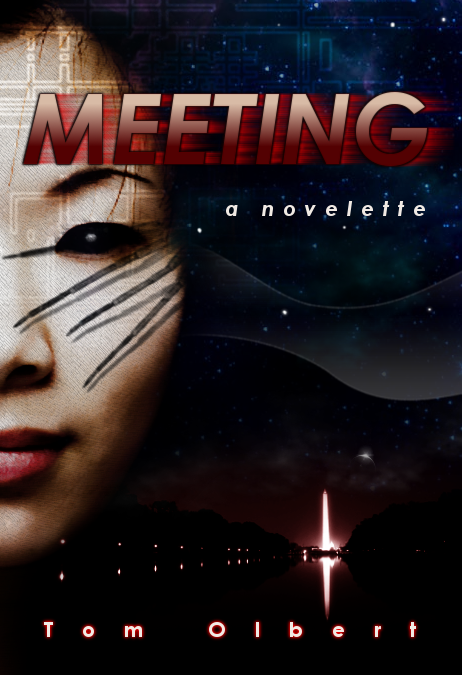
http://www.lillibridgepress.com/book/Meeting

As nature's fury subsides, the sea grows calm again, clear blue skies and sunshine return, and the wreckage is cleared away, we bid farewell to Hurricane Irene and return to our normal (such as that is) lives.  Some say the warnings were exaggerated and foolish.  Others will say, and rightly so, that New York City dodged a bullet.  Tragically, New Orleans wasn't so lucky.  Which city will be next?

Once again, science fiction laps at the shores of everyday reality.  Time was, a tidal wave threat to the towering skyscrapers of New York was confined to sci-fi films.  We just got a taste of the new reality.  The hurricane that just swept menacingly up the eastern seaboard was unprecedented in size; seen from space, it was a living horror that only a few short years ago, existed only in the minds of climatologists and science fiction writers.  Like all storms, its power dissipated as it moved inland.  But, the power of storms continues to increase as the ocean's temperature continues to rise due to man-made climate change.

In the space of a decade, climate change has altered our planet more dramatically than even sci-fi had ever envisioned.  New frontiers have opened in a world that supposedly ran out of them a long time ago.  There are now adventurers setting out to row to the north pole; a physical impossibility not long ago.  Once foreboding and impenetrable walls of ice receding, regions of this globe, some at towering altitudes once inaccessible to Man, are now becoming tourist attractions.  As the ice continues to melt, strange new forms of deep sea life, exotic and beautiful beyond the ability of even the most fertile imaginations to conceive are being seen by human eyes for the first time.  But, there is devastation as well.  Species diversity is dwindling as the noble polar bear and many other species are threatened with extinction.  Wildfires, floods and violent storms plague the United States while drought devastates Africa.

Human industry is the cause of these unnatural changes.  But though, as a species, we had the power to bring these changes about, we seem to lack either the ability or the will to reverse them.  Some say it's already too late to reverse the effects of climate change, and that we'd better get busy adapting to the inevitable challenges ahead.  It is undeniably true that the ability to adapt is the difference between survival and extinction for any species, ourselves included.  But, how are we to adapt to so rapidly changing a world?  Recent history has grimly demonstrated that entrenched economic interests, bloated corporations and their political servants will continue to make difficult, if not impossible, any meaningful federal-level legislation to reduce carbon emissions.

But, in making meaningful changes to our nation's energy grid, slowing down the rate of climate change and working toward adapting ourselves to those effects already on the way, smaller may be better.  More can perhaps be accomplished at the city level than at the federal level. (see September issue of Scientific American.) New Orleans (and now New York) was our wake-up call.  Some cities are already modifying architectural and energy production strategies toward the twin goals of reducing carbon emissions and making cities better prepared to weather the next superstorm to come their way.  The vision of several mayors and urban planners is to make the cities of the future greener and more energy efficient, in order to preserve our environment and our way of life.  Since the federal government...as always, torn by self-serving political agendas and rivalries...has failed to pass any meaningful overall standard of carbon emissions, it may now be up to cities to coordinate such standards between them.  And, since the poor would (as usual) be hit the hardest by the deleterious effects of climate change, it would behoove city governments serious about reducing carbon emissions to reach out to those communities in the greatest need and help them to conserve and use energy wisely and efficiently.

Adapting to climate change may eventually trigger a brave new world of creative and scientifically guided urban planning, and a genuine effort to narrow the gap between rich and poor and work toward economic justice (something every society needs to do in order to create a healthy and thriving democracy.)  Change for the sake of survival is what shapes a species.  But, as we are the only species that consciously creates it's own circumstances, we are, for better or worse, truly the masters of our fate.

Thursday, June 30, 2011

Nuclear Fire


Once again, nightmarish situations once seen only in science fiction break through into the real world as grim reminders that the human race can affect nature with devastating consequences.

For decades, climatologists warned a skeptical public that climate change due to excessive burning of fossil fuels could lead to (among other things) large-scale brush fires.  Sure enough, that's exactly what we're seeing in several American states:  infernos that are all too real.

Now, some of those wildfires are getting dangerously close to nuclear power plants, threatening to damage or destroy the control systems that keep the nuclear cores contained.  Some consider nuclear power to be a "safer" alternative to fossil fuels, since it does not contribute to carbon emissions.  It does however produce deadly nuclear waste which is next to impossible to get rid of.  And, let us not forget the hellish disaster of Chernobyl.  It would be bitterly ironic if the very wildfires caused by fossil fuel consumption let the nuclear demon out of its cage.

We've recently witnessed a potential nuclear disaster in the making in Japan, as the result of tsunami.  So great is the threat, that Germany today announced it was shutting down its own nuclear industry.  We should wise up and follow their example.  Better yet, we should phase out fossil fuel consumption as well, switching to truly safer alternatives such as wind, solar, hydro and natural gas, before more such disasters materialize.

In the dark fantasies of fiction, the misguided think they can control their destinies through a caged demon at their command.  They always learn the hard way that the cage isn't as strong as they think.

Sunday, May 29, 2011

Cate Masters - Author Spotlight

Check out my author interview, and other interesting news about unusual and paranormal fiction at Cate Masters fabulous blog:

http://catemasters.blogspot.com/2010/05/thomas-olbert-in-author-spotlight.html

Wednesday, April 27, 2011

Imaginary Monsters, Real Horror...

Fiction abounds with imaginary monsters of the dark imagination.  But, in real life, more people in these strange times seem to recoil from other kinds of imaginary monsters than from the real dangers and dilemmas that threaten our future.
In a real-life horror story, storms and floods are devastating communities in the southern United States with unprecedented ferocity as the death toll mounts.  Yet, no one dares even consider that man-made global warming might be a contributing factor.  That's just a hoax; global warming's not real.  The ecological consequences of industrial oil spills continue to manifest, yet still no outcry from the public in favor of more government oversight of corporations trying to dismantle what little remains of environmental protection laws.  Everyone knows corporations are more trustworthy than the government.  The evidence of their own senses aside, the public continues to deny the dangers literally destroying their homes daily.
 So, what does the public fear?  What are the monsters that frighten them?  They fear the president might be an illegal alien.   They fear that efforts to make healthcare affordable and corporations manageable are communist plots to re-distribute wealth and promote class warfare.    The cold war is long over, yet they look at Barack Obama and see Stalin's ghost.
Why?  Are we a nation of children unready to face the unpleasant facts of life and choosing instead to live in a world of fantasy and imaginary monsters?  Is it that we've lost the ability to distinguish fact from fantasy?  Is technology to blame?  Is it that cyber-space has proven so enticing a refuge from these paranoid times that opinion blogging has become a substitute for reality?  Have we become so alienated, not only from our own government, but from life itself that pompous reality T.V. clowns with their bald-faced lies and empty rhetoric become more viable candidates for the presidency than people who dwell in the real world?  Has fantasy truly taken the place of substance?
Or, is the source of the madness a much older monster; Racism?  Do we concoct these elaborate paranoid fantasies of forged passports and communist conspiracies merely to cloud the ugly, bigoted face we don't want to see in the mirror?  We create imaginary monsters to hide the real monsters we'd rather not have to fight or acknowledge.   The saddest part is, we created the real ones, too.